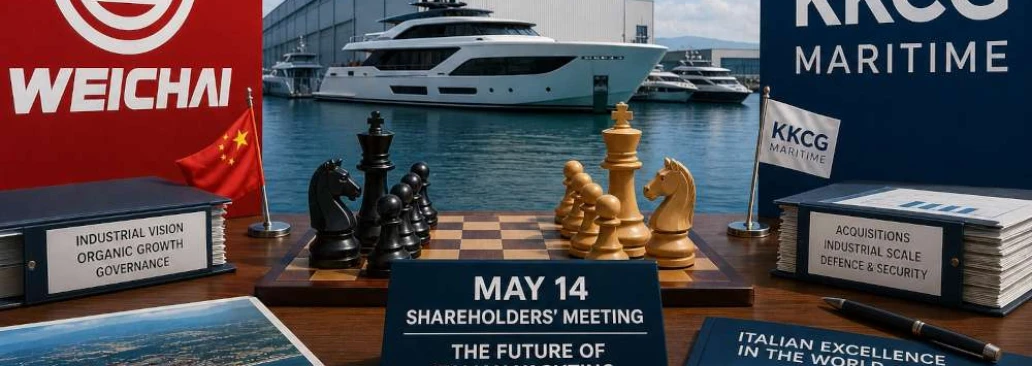
With only a few days to go before 14 May, the atmosphere surrounding Ferretti Group is far removed from that of a relaxed yacht club regatta. This time, the stakes are not symbolic: whoever loses does not simply give up a trophy, but potentially control of one of the leading players in the global yacht industry. In 2025, the group reported revenues of €1.23 billion, EBITDA of €202.8 million and net profit of €90.1 million (+2.2%), with an order backlog of around €1.7 billion. Growth versus 2024 was moderate, but within a market that has shown signs of slowdown, these figures point to a company in solid health.
As the shareholders’ meeting to renew the board of directors approaches, what had long been a purely financial contest—Weichai holding roughly 37–39%, and KKCG Maritime rising above 23%—has now shifted into the open. Interviews, public statements and contrasting narratives have turned the confrontation between the two main shareholders into a fully public debate.
It is no longer just about ownership. It is about the direction in which the group is heading.
Karel Komárek, founder of KKCG Maritime, outlines a strategy centred on growth across the entire value chain: targeted acquisitions in services, supply chain integration and potential consolidation among shipyards and brands. Industrial scale and competitive positioning are key elements, alongside a renewed focus on defence—an area that, given current geopolitical dynamics and rising military spending, is far from marginal.
Weichai, for its part, takes a more critical view of recent years. From the Chinese shareholder’s perspective, organic growth has been insufficient, international expansion below expectations and profitability still open to improvement. The conclusion is clear: a change in leadership is needed to enter a new phase with a different approach.
In this context, CEO Alberto Galassi has taken a position that is anything but neutral. In office since 2014, he has openly aligned with the KKCG proposal, criticising Weichai for what he describes as a lack of industrial vision and slower decision-making processes. His priorities are equally clear: M&A, a more active use of financial tools and the relaunch of the Security & Defence division. His remarks read less like a defence and more like a forward-looking programme. Governance has therefore become the real battleground. KKCG focuses on continuity combined with a more dynamic strategic approach, while Weichai is pushing for a break with the current management model, including at the top level.
Beyond the immediate confrontation, however, there is a broader context that cannot be overlooked. Italian yachting is not just another industrial segment. It is a sector where engineering, manufacturing and design capabilities converge into a model that continues to attract global attention. Ferretti is part of this system—not only as a brand, but as an expression of a wider industrial ecosystem built on specialised suppliers, technical expertise and a balance between craftsmanship and innovation.
The regional context reinforces this picture. Emilia-Romagna, where Ferretti is headquartered in Forlì, remains one of the core hubs of Italian boatbuilding. In 2025, exports from the regional leisure boating sector exceeded €800 million, with 287 companies and more than 3,600 employees generating around €1.6 billion in total revenue. These are not indicators of a struggling industry, but of a functioning and competitive ecosystem.
For this reason, the outcome of the 14 May meeting will go beyond the appointment of a new board. It will signal which industrial approach will prevail: one focused on expansion, consolidation and the activation of financial and strategic levers, or one oriented towards reassessment and a different management structure. Two distinct visions of how to operate in a complex sector such as yachting.
Investors, operators and suppliers are watching closely. This time, however, the expectation goes beyond the immediate result. At stake is also a broader question: how to preserve and further develop one of the few industrial sectors in which Italy continues to play a leading role on the global stage.